Thứ Hai, 4 tháng 9, 2017

How to set up Windows on Mac

How to install Windows on your Mac with Boot Camp

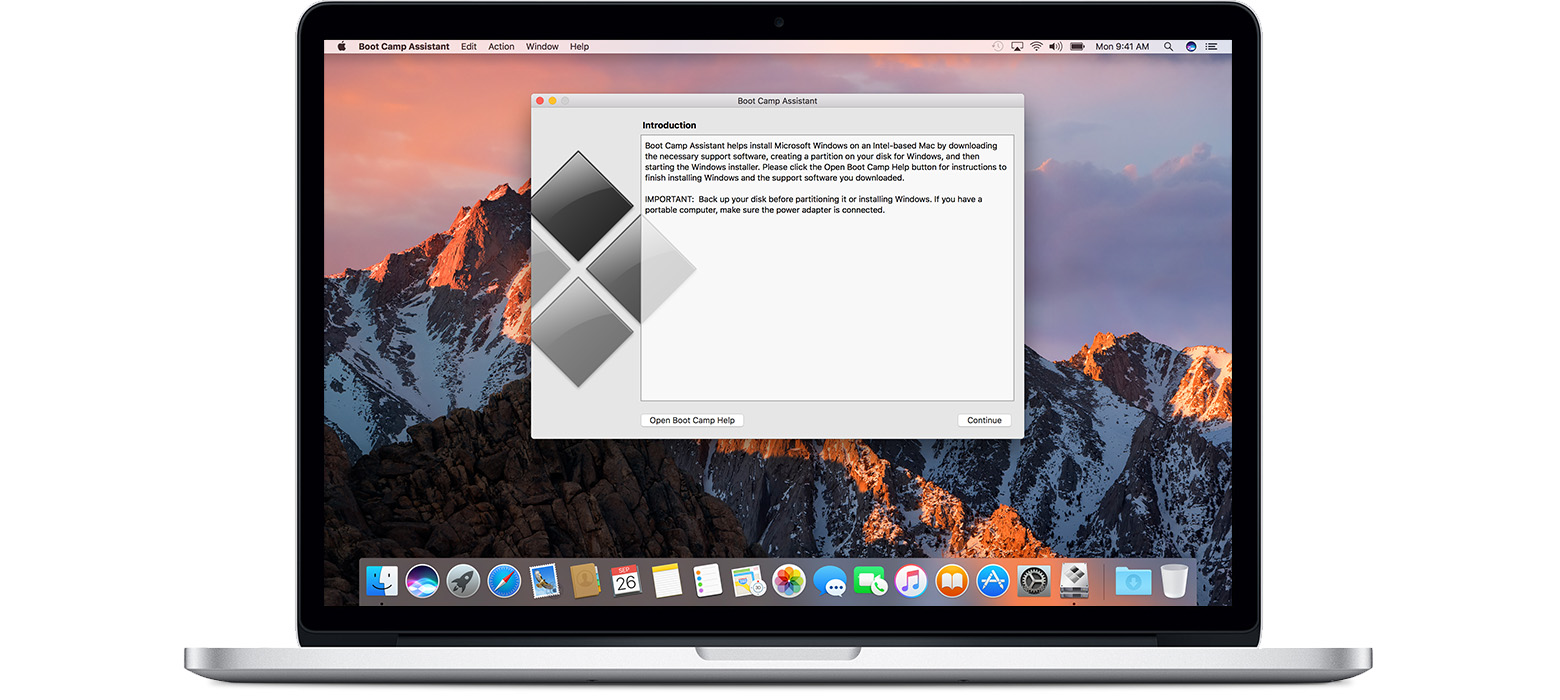
Boot Camp helps you install Microsoft Windows on your Mac. After you install, restart your Mac to switch between macOS and Windows.
How to set up Windows on Mac
Before you begin, make sure you have everything you need:
  • An Intel-based Mac
  • A Microsoft Windows installation media or disk image (ISO) containing a 64-bit version of Microsoft Windows 8 or later
    Read more about system requirements to find out whether your Mac supports installing a specific version of Windows, or to learn about installing older versions of Windows. If you're installing Windows for the first time, use a full installation (not an upgrade) disc or disk image.
  • An Apple keyboard, mouse, or trackpad, or a USB keyboard and mouse
  • At least 55GB of free disk space on your startup drive
  • A blank 16GB or larger USB 2 flash drive
    If you have one of these Mac models, you don't need a flash drive.

Check System Requirements

Some versions of Windows require a certain processor and more hard drive space and memory (RAM) than others. Check the documentation that came with your copy of Windows to find out what you need. Then use System Information to see what your Mac currently has.

Get a Windows disk image

When you buy Windows, it comes as a disk image file (ISO) that you download, or as an installation disc or USB flash drive. If your copy of Windows came on a DVD, you might need to create a disk image of it to work with Boot Camp. If your version of Windows came on a USB flash drive, you can download an ISO from Microsoft.

Open Boot Camp Assistant

Boot Camp Assistant guides you through installing Windows on your Mac. Open this app from the Utilities folder inside the Applications folder. Then follow the onscreen instructions to repartition your startup disk and download related software drivers for Windows. If you're prompted during installation, connect a blank USB 2 flash drive.

Format your Windows partition

When you complete the assistant, your Mac restarts to the Windows installer. When you're asked where you want to install Windows, select the BOOTCAMP partition, then click Format.
This step is only required if you're using a flash drive or optical drive to install Windows. In all other cases, the correct partition is selected and automatically formatted for you.
 

Install Windows

Follow the onscreen prompts to finish your Windows installation.

Restart your Mac

After Windows is installed, restart when you want to switch between macOS and Windows. Use the Startup Disk preference pane in macOS or the Boot Camp system tray item in Windows to select your startup disk, then restart your computer.

Learn more

With OS X El Capitan 10.11 or later, these models use the internal drive to temporarily store what you need to install Windows, so you don't need a USB flash drive:
  • MacBook Pro (2015 and later)
  • MacBook Air (2015 and later)
  • MacBook (2015 and later)
  • iMac (2015 and later)
  • Mac Pro (Late 2013)

14 Methods for Improving Your Spoken English Without a Speaking Partner

14 Methods for Improving Your Spoken English Without a Speaking Partner


So, you’re all by yourself. Forever alone.
Okay, maybe you’re not forever alone, but right now you need to practice English alone.
How can you practice speaking English without anybody else to help you?
Writing, reading, listening—these skills can all be practiced alone. Easy.
Well, you can already write beautiful sentences. You memorized hundreds of vocabulary words.
But when you open your mouth to speak, nothing comes out!
All the books, websites and apps in the world can’t help you learn how to speak English fluently. 
To improve your spoken English, the best thing to do is to talk with a native speaker.
Sometimes we don’t have that option though! What if you don’t know anyone who speaks English? What if you don’t have time? What if you simply don’t feel confident enough yet to practice with a native?
Don’t worry. You can still improve your spoken English, even without a speaking partner.
We’re going to explain how. No speaking partner? No problem!

14 Methods for Improving Your Spoken English Without a Speaking Partner

1. Think in English.

Sometimes the difficult thing about talking in a new language isn’t the language itself, but how you think about it.
If you think in your native language and then try to speak English, you’ll always have to translate between languages. Translating isn’t an easy thing to do! Even people fluent in two or more languages have trouble switching between languages.
The solution is to think in English. 
You can do this anywhere, anytime. Try to use English when you’re thinking about your day, or when you’re trying to decide what food to order. Even try to use an English to English dictionary to look up words. That way you never have to use your native language and translate words. You’ll notice that when you think in English, it’s easier for you to speak in English.

2. Talk to yourself.

Whenever you’re at home (or alone somewhere else) you can practice your English with your favorite person: yourself.
If you’re already thinking in English, try speaking your thoughts out loud. Read out loud, too. Practice is practice, and even if you don’t have anyone to correct your mistakes, just the act of speaking out loud will help you become more comfortable speaking English.

3. Use a mirror.

Whenever you can, take a few minutes out of your day to stand in front of the mirror and speak. Choose a topic, set a timer for 2 or 3 minutes and just talk.
The point of this exercise is to watch your mouth, face and body language as you speak. It also makes you feel like you’re talking to someone, so you can pretend you’re having a discussion with a study buddy.
Talk for the full 2 or 3 minutes. Don’t stop! If you get stuck on a word you don’t know, try expressing your idea in a different way. You can always look up how to say that word after the 2-3 minutes end. This will definitely help you find out what kinds of words or sentences you have trouble with.

4. Focus on fluency, not grammar.

When you speak in English, how often do you stop?
The more you stop, the less confident you sound and the less comfortable you become. Try the mirror exercise above, but challenge yourself to speak without stopping or stammering (taking pauses between your words) the entire time.
This might mean that your sentences won’t be grammatically perfect, and that’s okay! If you focus on speaking fluently instead of correctly, you’ll still be understood and you’ll sound better. You can fill in the correct grammar and word rules as you learn them better.

5. Try some tongue twisters.

Tongue twisters are series of words that are difficult to say quickly. One example is: “The thirty-three thieves thought that they thrilled the throne throughout Thursday.” Try saying this a few times! It’s not easy.
Word games like this will help you find the right placement for your mouth and tongue, and can even help your pronunciation. You can find a list of great tongue twisters here.

6. Listen and repeat.

Do you watch TV shows or YouTube videos in English? Use them to improve your fluency. Choose a short part of a show and repeat it line by line. Try to match the tone, speed and even the accent (if you can). It doesn’t matter if you miss a few words, the important thing is to keep talking. Try to sound just like the native speakers on the show.

Time catches up with Lin Dan after World Championshp defeat to Viktor Axelsen

Time catches up with Lin Dan after World Championshp defeat to Viktor Axelsen


The 33-year-old "Super Dan" said that he would return for China's National Games and then play at next month's Japan Open.

Shanghai: Lin Dan's defeat in the World Championship final has prompted fresh conjecture that the Chinese super star could soon call time on his brilliant career.
The 33-year-old "Super Dan" said after losing Sunday's showdown to Denmark's Viktor Axelsen in Glasgow that he would immediately return for China's National Games and then play at next month's Japan Open.
"After that I have no plans," said Lin, indicating he might soon call it a day. "It will be difficult to play in the World Championships at 34."
But the two-time Olympic and five-time world champion, regarded widely as the greatest singles player of all time, mixed his message by adding that reaching the final against a player 10 years younger "showed that I am still strong enough physically".
Lin was the bad boy of Chinese sport in his younger days, with a rap sheet that included hitting a coach. And he has hinted at retirement before, only to plough on.
Lin proved his enduring quality in Scotland by beating South Korea's world number one Son Wan-Ho in the semi-finals, before going down to the 23-year-old Axelsen in what felt like a changing of the guard.
"It is unbelievable to beat Lin Dan, I have been watching him for years," said the Dane.
As he nears the end of his career, Lin has been cherry-picking his tournament appearances to help extend his time at the top, like 36-year-old Roger Federer who has enjoyed a resurgence this year to win two tennis grand slams.

'I don't want to go       
Lin has fallen to seventh in the world rankings and fans on China's Twitter-like Weibo, where he has 3.75 million followers, said he lost the final to Old Father Time rather than his Danish opponent.
"The best players will always lose to time/age in the end. Even in defeat Lin Dan deserves to be honoured and respected. You will always be Super Dan," said one.
But many were more concerned with Lin's love life which has made more headlines than his badminton in the past year.
The once sky-high popularity of the tattooed shuttler --  it is rare for Chinese athletes to have tattoos -- has never recovered fully despite Lin apologising in November last year for an affair with a model while his wife and former badminton starlet Xie Xingfang was pregnant.
Observers said Lin showed his advancing years had slowed him in the defeat to world number three Axelsen.
"We all hoped to see Super Dan continue his legacy, but objectively speaking there's a 10-year age gap between the two players, think about the extra effort that has to be put in," commentator Tong Kexin said on state television after the defeat.
Many people expected Lin to retire after last summer's Rio Olympics, where he surrendered his title and lost the bronze-medal match to Axelsen.
But a reply Lin gave to Chinese media offers an insight into why he continues to defy expectations. Asked in 2014 what he would say in a retirement speech if given only one minute, he answered: "I would say 'I don't want to go' and repeat it for 60 seconds."
https://www.youtube.com/watch?v=-tuuKhFjjp4

Thứ Sáu, 25 tháng 8, 2017

The importance of learning English

  1. English is the most commonly spoken language in the world. One out of five people can speak or at least understand English!
     
  2. English is the language of science, of aviation, computers, diplomacy, and tourism. Knowing English increases your chances of getting a good job in a multinational company within your home country or of finding work abroad.
     
  3. English is the official language of 53 countries. That is a lot of people to meet and speak to.
     
  4. English is spoken as a first language by around 400 million people around the world.
     
  5. English is the language of the media industry. If you speak English, you won’t need to rely on translations and subtitles anymore to enjoy your favourite books, songs, films and TV shows.
     
  6. English is also the language of the Internet. Many websites are written in English – you will be able to understand them and to take part in forums and discussions.
     
  7. English is based on a simple alphabet and it is fairly quick and easy to learn compared to other languages.
     
  8. English is not only useful — it gives you a lot of satisfaction. Making progress feels great. You will enjoy learning English, if you remember that every hour you spend gets you closer to perfection.
     
  9. Since English is spoken in so many different countries there are thousands of schools around the world that offer programmes in English. If you speak English, there’re lots of opportunities for you to find an appropriate school and course to suit your academic needs.
     
  10. Because it’s fun! By learning English, you will also learn about other cultures. Few experiences will make you grow as a person more than learning the values, habits and way of life in a culture that is different from yours.